BLYTHE DRIVEWAYS. Drag the handle and the old drive comes back.
- A Solihull driveways firm across twenty eight pages, built as a prelaunch concept rather than a fiction: the site is finished, the business is not open yet.
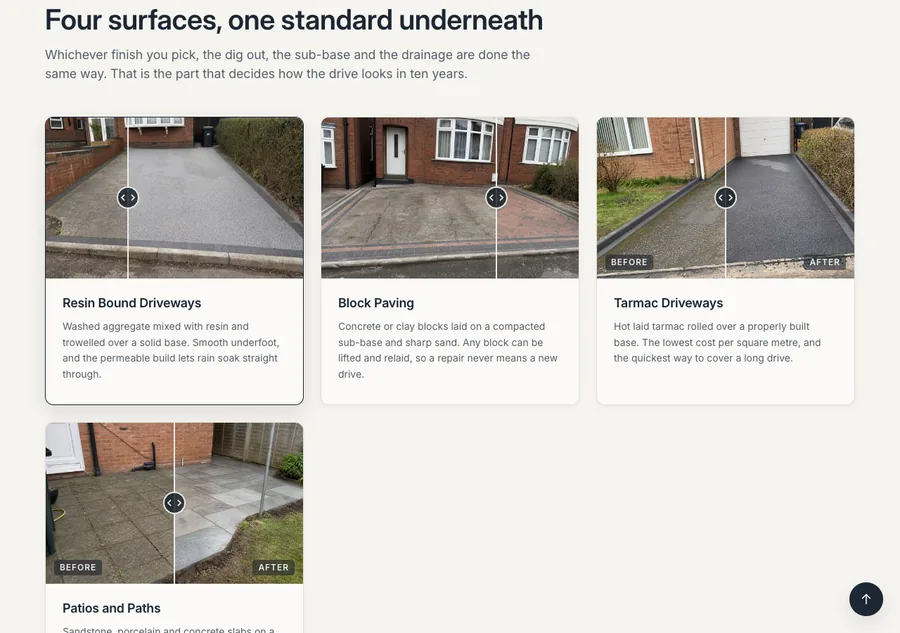
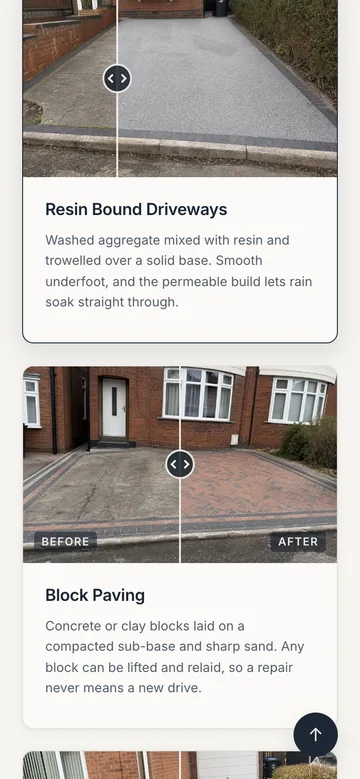
- Every service card carries a before and after slider. Drag the handle and the finished drive gives way to the surface it replaced.
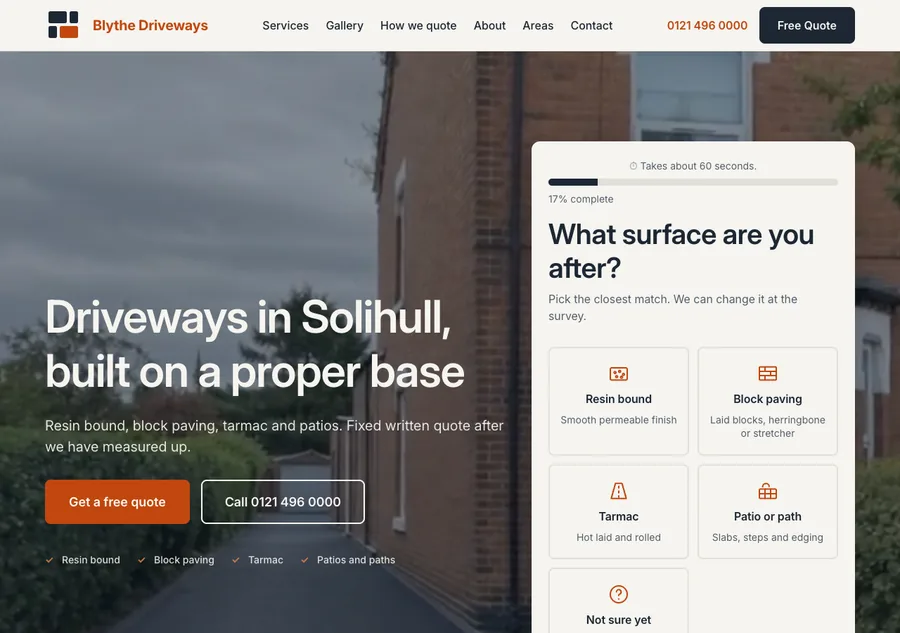
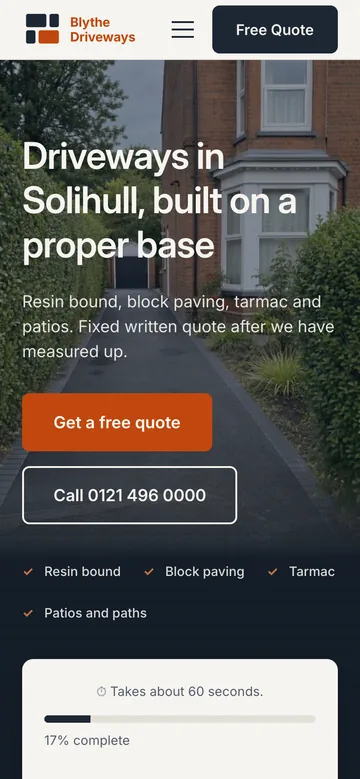
- The hero is a twelve second film of three houses, and phones get their own portrait cut rather than a landscape one cropped down.
A studio concept, prelaunch
Blythe Driveways is a studio concept, built to launch rather than to demonstrate. The business is not trading yet, so the phone number is an Ofcom number reserved for fiction and the enquiry forms are not wired to a live inbox. We build self initiated projects to show our approach where client work cannot: the brief is real, and so is every line of the build.
The brief
A driveway is bought with the eyes, and yet almost every contractor site presents the work the same way: a grid of finished photographs you are left to interpret alone. You see a nice drive. You do not see what was there before, which is the only comparison that means anything to someone standing on cracked concrete.
The trade also carries a trust problem it did not entirely earn. Cold calling, cash jobs, quotes that move once the diggers arrive. Every homeowner researching a drive has heard the stories, and most sites answer them with a badge rather than a sentence.
So the brief had two halves. Show the transformation directly rather than asking anyone to imagine it, and answer the trust questions in writing before the phone is ever picked up.
The concept
The before and after lives inside the service card itself. Each of the four surfaces carries a slider: the finished drive underneath, the surface it replaced clipped over the top, a handle splitting the two. Drag it, or use the arrow keys, and the old drive comes back. Putting it in the card makes the comparison the first thing on the homepage rather than a reward for scrolling.
The hero is three houses, each a slow lateral drift, crossfaded into a twelve second loop that closes tail into head with no visible join. The light is deliberately overcast, because bright sun flattens a surface and the surface is the point.
Phones are not an afterthought. A landscape film cropped to a portrait screen loses the drive, so phones get a second film shot portrait, chosen by viewport at load.
The specification
- Twenty eight static pages, hand coded, British English, no framework
- Nineteen imagery slots plus four matched before frames, every image generated for this build
- Four before and after sliders, pointer driven, keyboard accessible, 44 pixel handle
- A 12.79 second 1280 by 720 desktop hero loop at 1.38MB, three houses crossfaded
- A separate portrait hero loop for phones at 1.25MB, not a cropped landscape one
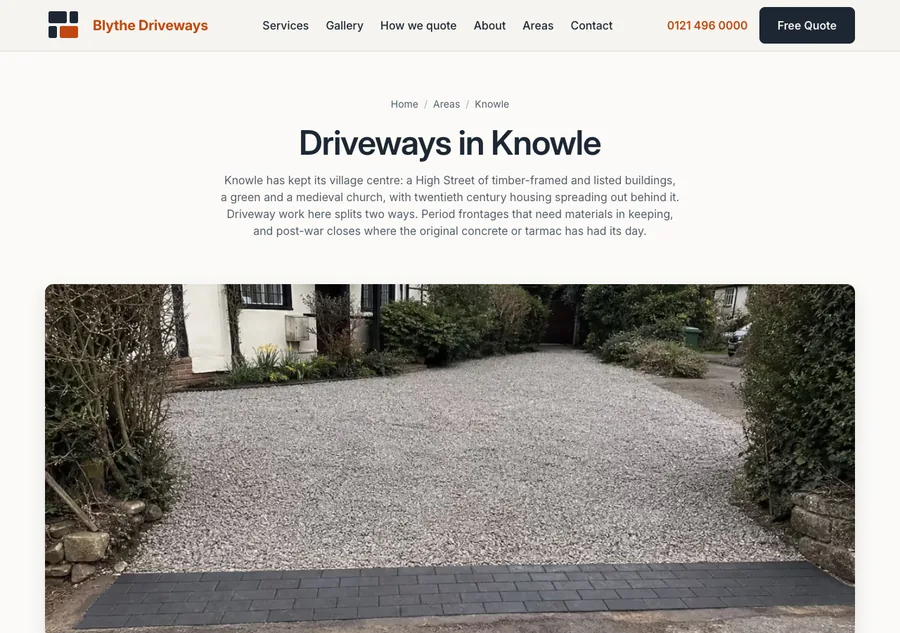
- Six Solihull area pages written from named local sources
- A six step quote flow, two guide posts and ten answered questions
- A reduced motion path that fetches no video bytes at all
- Link gate: 1,345 internal targets resolved on the live build, none broken
What Hammer & Pixel built
- The full twenty eight page site: four surfaces, six areas, gallery, guides, guarantees and the quote flow
- The slider module: before and after inside the service card, drag or arrow keys, and phone scrolling that never fights the drag
- The hero pipeline: stills, motion, two pass stabilisation, then a crossfaded loop closed tail into head
- The portrait hero: a second film shot for phones rather than a crop, chosen by viewport at load
- The local layer: six areas written from conservation area dates, ground conditions and the council's own dropped kerb process
Proof
Desktop and phone stills
Walkthrough film
Want this thinking on your own brand?
Serious enquiries receive a homepage concept for their own brand before any commitment. One page, designed properly, so you judge us on work rather than promises.
On Upwork? Message us there instead.