
Tree removal and felling in St Albans
Straight fells where there is room to drop it, sectional dismantling where there is not. Either way the permission question gets answered before the price does.
Before anything else: is it allowed to come down?
A removal is the one job you cannot undo, so it is the one where the permission check matters most. If the tree carries a Tree Preservation Order you need written consent from the council, and they have up to eight weeks to decide. If it stands in one of the district's 19 conservation areas you need to give six weeks' written notice instead. Neither of those is optional, and the maximum fine for destroying a protected tree is £20,000 per tree.
We run that check as part of quoting, on every job, and we put what we find in writing. If the answer is that it cannot come down, you will hear that from us before you have spent anything. Full detail is on our protected trees page.
Straight fell or sectional dismantle
A straight fell is one cut sequence: a face cut, a back cut, and the tree lands where the hinge sends it. It is quick, it is cheap, and it needs a drop zone at least as long as the tree with nothing valuable in it. Open paddock, a big lawn, the back of a large plot.
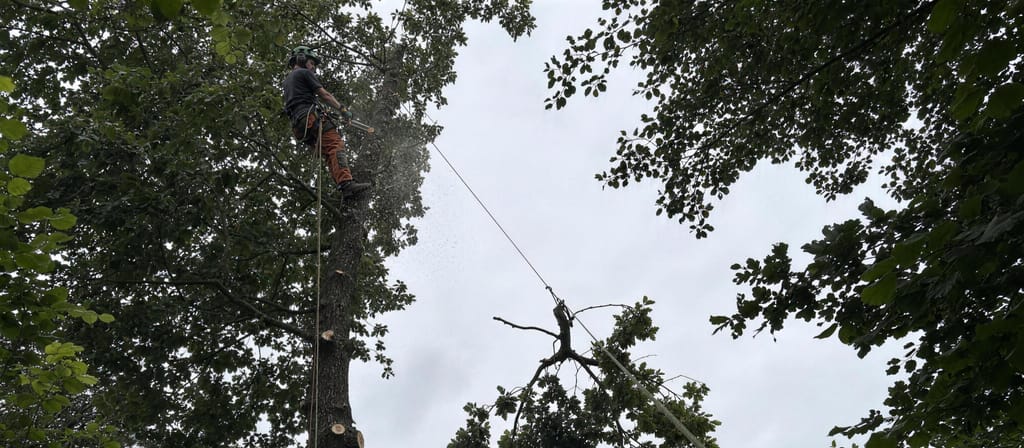
Most St Albans gardens do not have that, which is why the majority of removals here are sectional. The climber works up the tree taking limbs off in manageable pieces, either lowering them on ropes or letting them fall into a small clear space. The trunk then comes down in rounds. It takes longer and it costs more, and the reason is not the tree, it is what is underneath it.
Rigging over a target
Where a section cannot simply be dropped, it is rigged: tied off to a point higher in the tree, cut free, and lowered under control by someone on the ground. That is the difference between a limb landing on a conservatory roof and a limb landing beside it. Rigging adds time and it adds crew, and any quote that ignores a greenhouse, a fence line or a neighbour's shed is a quote that has not been thought through.
What decides the price
- Access. Whether a chipper can park next to the tree, come through a side gate, or not get in at all. This is usually the single biggest factor.
- What is underneath. Open lawn, or a patio, a pond, a greenhouse and a boundary wall.
- Size and species. A mature oak carries far more weight per metre than a birch of the same height.
- Waste. Chipped and taken, chipped and left as mulch, or logged and stacked for you.
- The stump. Left flush, or ground out. See stump grinding.
We publish no per-tree price list, because a price given without seeing the access is a guess. Ours comes from the visit and is fixed in writing before anyone starts.
What we leave behind
Brash chipped on site and taken away, or left as mulch if you want it. Timber cut to whatever length you ask for and stacked, or removed. The ground raked over. Sawdust does not vanish, so on a lawn expect to see where the tree was for a season, and on a patio expect us to sweep rather than pressure wash.
When removal is the wrong answer
Plenty of trees people want gone do not need to go. A tree blocking light can often be reduced. A tree dropping sap or fruit can be thinned. A tree that has been blamed for a crack in the wall may have nothing to do with it, and felling it first can make heave worse, not better. We will say so, even though a reduction is a smaller invoice than a removal. Where subsidence is the worry, start with a report, not a chainsaw.
Price up a removal
Tell us the postcode and roughly how big it is. We come out, check what is on it, and put a fixed price in writing.