
Fencing and fence repairs in Bishopston and Horfield
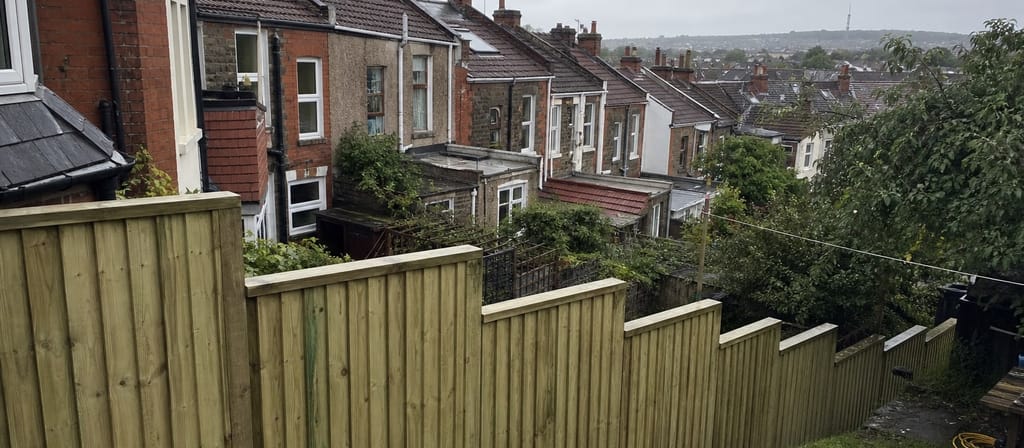
Bishopston and Horfield are Victorian terraces on long narrow gardens, laid out from the 1880s on old field boundaries off Gloucester Road. This is our own patch: Purdown is the ridge that runs above Horfield and Lockleaze.
About Bishopston and Horfield
The area grew fast. The population went from around 1,300 in 1862 to 9,140 by 1901, and the streets went in on the lines of the fields that were there before. Bristol City Council's own conservation appraisal describes the housing as predominantly two storey, bay fronted, pennant sandstone or brick, semi detached and terraced. What that means for fencing is a long thin garden with a boundary on both sides, a shared rear line at the end, and no way in except through the house or down a narrow side return. Access is the number that moves the price here, not the length of the run, and we ask about it before we quote rather than discovering it on the day.
What you are allowed to put up in Bishopston and Horfield
Most of residential Bishopston and Horfield is not in a conservation area. The Gloucester Road conservation area, Bristol's thirty-third, was adopted on 4 April 2017 and covers the shopping frontage plus North Road rather than the streets behind. So for most gardens here the national rule is the one that applies: up to 2 metres generally, and no more than 1 metre where the boundary borders a highway used by vehicles or its footpath, which is the rule that catches front gardens on a through road. If your address is inside the Gloucester Road boundary, or you are near the Henleaze Article 4 area to the north west, the position changes and we check it with the council before pricing.
The boundaries round here
The old field lines mean rear boundaries are frequently shared between several properties and frequently older than the houses. Expect a mix of failing closeboard, panel fencing put in at different times by different owners, and the occasional pennant stone wall that predates the terrace. Replacing one owner's section of a shared rear line without agreeing it first is how a straightforward job turns into a dispute, so we establish the deeds position before anything is priced.
Wind, ground and what actually fails
Two different situations within a mile of each other. Gloucester Road sits at the low point of a valley, cut by the culverted Cutlers Mill and Horfield brooks, with the streets rising on both sides of it, so gardens down there are relatively sheltered and relatively damp. Horfield Common is by contrast one of the highest points in Bristol, and boundaries up on that ground take the full south westerly. Wet ground argues for gravel boards and concrete posts, exposed ground argues for the same thing for a different reason.
Bishopston and Horfield postcodes we cover
BS7.
Which council covers Bishopston and Horfield
Bishopston and Horfield is Bristol City Council ground, and that is the authority whose rules we work to on your address. It matters more here than most people expect: our patch straddles a council boundary, so a rule that applies on one street can have no force at all a mile away. We check the right authority's conservation area map and its Article 4 Directions against your postcode before we price anything, and we tell you what we found. The full picture is in our guide to fence height and planning permission in Bristol.
What we do in Bishopston and Horfield
- Boundary checked before we quote Whose fence it is, and what the council allows on that street, settled first.
- Fixed written quotes Measured length, height, materials, waste and price on one sheet.
- No cold calling, ever We never knock doors after a storm and we never leaflet a price.
- Insured installers Public liability cover on every job. Ask and we send the certificate.
Get a price in Bishopston and Horfield
Free visit, a proper measure, the boundary checked, then a fixed price in writing.