
Posts, concrete and gravel boards in Bristol
When a fence goes over here it is nearly always the post that went, not the panel. This is the part of the job nobody sees and the part that decides how long everything above it lasts.
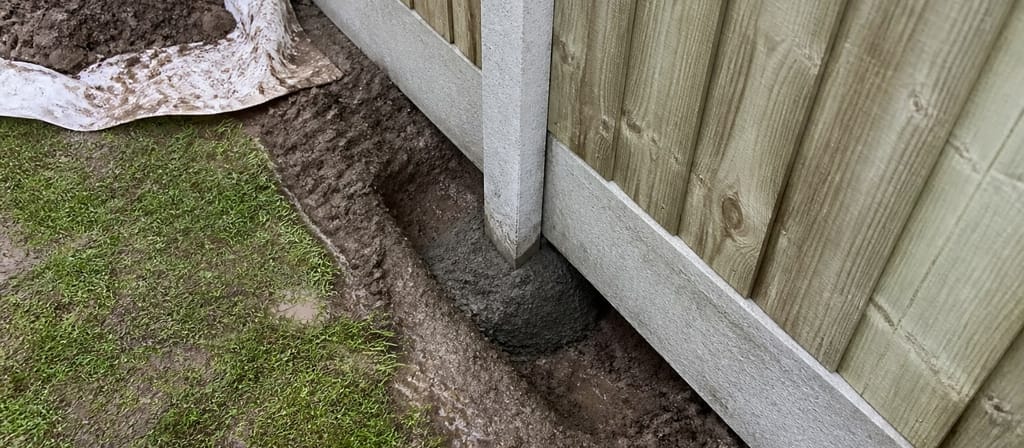
Concrete posts or timber posts
Both are right somewhere, and anyone who says one of them is always the answer is selling what is on the lorry.
Concrete. It does not rot at ground level, which is exactly where timber posts die. Slotted concrete takes panels and gravel boards straight in with no fixings, so a damaged panel lifts out and a new one drops in without touching the post. Against that: heavy down a narrow side return, it chips at the slot, it cracks rather than bends, and it looks like what it is.
Timber. It looks better, and on a closeboard run it is what most people want to see. It takes a fixing anywhere along its length, so gates, trellis and wires are simple. It will rot at ground level eventually, and the ones that last are set properly in the first place.
A mix, which is often what we recommend. Concrete gravel boards under timber posts, or concrete posts along the wet end of a boundary and timber where it is seen from the kitchen. What the timber is and how it is treated is on the timber and post guide.
What a gravel board actually does
It is the board that sits on the ground under the panel, so that the panel does not. That is the whole job, and it is worth more than it costs.
- It keeps the bottom edge of the panel clear of standing water and off the soil, which is where rot starts and spreads fastest.
- It takes the knocks: strimmers, wheelbarrows, dogs digging the line, a border pushed up against the fence.
- It is the cheapest piece on the fence and the quickest to swap. It is meant to go first so the panel above it does not.
Timber boards match a timber fence and are the cheaper start. Concrete ones outlast everything above them and are the better call on the valley floors, where the ground holds water long after the rain stops.
What a proper post setting looks like
Ours, in order, so you know what you are paying for when one quote comes in cheaper than another.
- A dug hole, not a driven slot. Wide enough to get concrete all the way round. A post wedged in tight with a bit of mix poured after has nothing holding the far side.
- Depth off the height of the fence. The taller the fence, the harder the wind works the post at its base, so a 1.8 metre run goes deeper than a 1.2 metre one. We work to roughly a third of the height above ground being in the ground.
- Something under the foot. Hardcore or concrete beneath the post, so it is not standing in a hole that fills every winter.
- A collar that sheds water. The concrete finishes proud of the ground and slopes away from the post. A flat or dished collar is a water trap, and the commonest reason a post set in concrete still rotted at the base.
- Time before load. Plumbed, braced, and left to go off before rails or panels go near it.
What is under a Bristol garden
Bristol is not one ground, and a post hole in Clifton is a different afternoon to a post hole in Fishponds.
The British Geological Survey flags the Lias Group as containing swelling and shrinking smectite clay, with medium volume-change potential and some high layers. Alluvium floors the Avon and Frome valleys, typically less than 5 metres thick. Carboniferous Limestone forms the Avon Gorge at Clifton, and Pennant Sandstone underlies much of east Bristol.
Published British Geological Survey mapping, quoted because it changes the digging, the hole and the price. It is a guide to what is likely under a garden, not a survey of yours.
What that means with a spade in your hand:
- Shrink and swell clay moves with the seasons. It grips a post through a wet winter and pulls back in a dry summer, and over a few years that works a narrow setting loose. On clay we dig wider rather than simply deeper, so there is concrete all round instead of a thin skin.
- Valley alluvium is soft and wet. Holes want to collapse while you work, and post feet end up standing in water. This is the ground where concrete posts and concrete gravel boards earn their money.
- Limestone and Pennant Sandstone stop the hole where they want to. Hit rock at half the depth you wanted and the answer changes: a breaker, or a shallower setting with a wider collar. Either way it belongs in the quote, not a phone call from the garden.
Kingswood, and the old coal ground
Kingswood needs its own paragraph. The coal mining history still affects the town, with gardens occasionally opening up, and the area sits inside a Coal Authority development high risk area. Siston Hill Colliery shafts reached around 170 metres.
For a fence that means one thing above all: we look at what a post hole is going into before we dig it, and if the ground looks wrong we stop and say so. Our Kingswood page covers the rest, including the fact that Kingswood is South Gloucestershire, so Bristol's conservation areas and Article 4 Directions have no force there.
Wind loading, and letting it through instead
A solid fence is a sail. Everything the wind pushes against the panel arrives at the bottom of the post as a bending force, and that is the point where the timber is weakest and wettest. Bristol's prevailing wind is south-westerly, off the Severn Estuary with a long Atlantic fetch behind it, so a west facing boundary takes most of it. Up at Clifton Down or Horfield Common a solid closeboard run carries far more load than the same fence in a sheltered valley garden a mile away.
Three ways to deal with that, and they are not equally good.
- Fight it. Bigger posts, deeper settings, concrete instead of timber. It works, it costs the most, and the fence still takes the full push.
- Let it through. Hit and miss boards leave a gap between each one, so air passes between them and the load on the post drops. It looks the same from both sides as a bonus. On an exposed boundary this is usually the better answer and it is rarely the one offered.
- Take height off. Dropping an exposed run from 1.8 metres to 1.5 metres takes a surprising amount off the posts. Not always acceptable for privacy, but worth knowing.
If your fence has already gone over, fence repairs and storm damage covers how we call a repair against a replacement.
Posts moving, or a run leaning?
Lean on each post before you ring and tell us how many rock. That one answer usually decides whether this is an afternoon or a whole new boundary. Weekdays 8am to 6pm, Saturday 8am to 1pm, and forms get a callback the next working morning.