
Composite fencing in Bristol
Recycled wood and plastic boards in aluminium or composite posts. It costs more than timber up front and never needs treating, so it pays the difference back slowly rather than quickly. Here is when that trade is worth making.
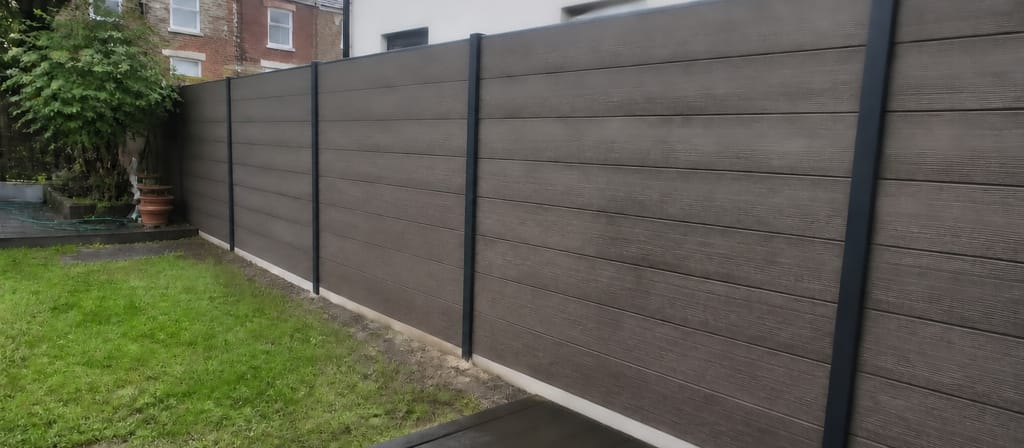
What composite fencing actually is
Composite boards are recycled wood fibre and recycled plastic, mixed and pressed into a solid board with a grain pressed into the face. They slot into channels in aluminium or composite posts rather than being nailed to a rail, so the run goes together as a kit of parts that has to be set out correctly first.
The plastic content is the point. It is what stops the board drinking water at the bottom edge, and water at the bottom edge is what finishes a timber fence in this city. Composite needs no treating, staining or painting, and it does not rot at ground level. That is the whole case for it, and it is narrower than the brochures suggest.
The money, honestly
Composite costs more up front than timber. Not slightly more. Boards, posts and fittings are all dearer, and the setting out takes longer, which puts the labour up as well. What you buy for that is a run you never treat again.
The payback is slow arithmetic rather than a quick win. Timber wants a coat of preservative every couple of years to reach its full life, and most people either do that or quietly do not. If you are the sort who does, composite buys back your weekends. If you never touch it, composite buys back the years the timber would have lost. Either way the difference comes back over a decade or more, not in three years, and anyone selling it as an instant saving is telling you a story.
For a published anchor rather than our own number: the Checkatrade directory for fencing contractors in Bristol quotes a range of about £832 to £1,887, with an average around £1,248. That band covers fencing generally, not composite specifically, and composite sits at the top of it or above.
Source: published third-party market figures for Bristol, quoted so you have something to sanity check any quote against, including ours. They are not our price list.
Where composite makes sense
- A boundary you cannot easily get back to. Behind a shed, tight against a bank, over a drop, or a rear line shared with three or four gardens where getting agreement twice is harder than paying more once.
- A damp valley garden. Bedminster and Southville sit on the Malago valley floor, Fishponds on the Frome. Standing water at the base of a post finishes most timber fences on that ground, and composite is indifferent to it.
- Somebody who is never going to treat timber. No judgement in that, it is most people, and composite is the right answer for a garden that will get no maintenance at all.
Where it does not
- A short run. Over four or five metres the extra cost is real money and the maintenance you are avoiding is one afternoon with a brush. The sums do not work.
- A tight budget. If the number matters more than the maintenance, timber wins, and we will say so on the phone rather than after the site visit.
- A conservation area street where it will look wrong. Bristol has 33 conservation areas covering roughly 30 percent of the city. A moulded board next to a pennant stone wall in Clifton, or against the limestone rubble walls the council specifically protects in Westbury-on-Trym, reads as exactly what it is.
- Matching a neighbour's timber. Composite next to weathered closeboard looks like two fences, because it is.
Appearance, fade and how it moves
The colour is decided at the factory, so what you pick is what you get for the life of the fence. Expect it to lighten. A composite board holds colour far better than untreated timber, but it is not colour-fast forever, and any supplier telling you it will never change is overselling. Look at a sample outdoors, wet as well as dry.
The bigger practical difference is movement. Composite expands and contracts along its length with heat more than timber does, which is why a run needs an expansion gap at the board ends and why the posts have to land on the right centres to allow for it. Board lengths are fixed and cannot be planed, scribed or fudged on site the way a timber board can.
Setting out matters more than it does with timber
With timber you adjust as you go: cut a board, scribe it into an old wall, close a gap. With composite you commit at the marking-out stage, so we peg the line, take levels off the high end and set every post before a single board goes in. That is our practice on a timber run too. On a composite run it is not optional.
Slopes make it sharper. Bristol boundaries are rarely level: Clifton Down alone rises from about 79 metres to 101 metres at the Observatory. On a fall, a composite run steps down in whole panel heights rather than raking with the ground, so the steps have to be planned across the full length before anything is ordered. We show you where they land on a drawing rather than let you find them on the day.
The height rules do not change
Composite gets no exemption. It is a fence like any other: permitted development up to 2 metres, or up to 1 metre where the boundary borders a highway used by vehicles or its footpath, with conservation areas, listed buildings and Article 4 Directions overriding that. In the Henleaze and Cotham and Redland Article 4 areas, taking the existing boundary down is the part that needs permission. The detail is on our planning, Article 4 and boundary checks page.
Our honest answer for most Bristol gardens is timber
We fit composite and we are happy to fit it. We are not going to pretend it is the right answer for the average garden here. Timber costs less, matches what is already standing on both sides, and can be repaired a panel at a time when a storm takes a section out. A closeboard run on concrete posts with gravel boards under it lasts a long time in this city, and most of the failures we get called to are the post rather than the board. A better post is a much cheaper fix than a different material.
If you are weighing the two up, the materials guide compares the timber options and the new fencing page sets out how a full run gets built. Tell us the length, the ground and the access, and we will say which one we would put in our own garden.
Composite or timber?
Send the length of the run and a photo of what is there now. We will price both and say which one we would fit.