
Fence panels replaced in Bristol
One panel, three panels or the whole side, swapped where the posts are still sound. It is the quickest job we do, and usually the cheapest way to close a gap in a boundary.
When a panel swap is genuinely the right answer
A panel job only works if the structure holding the panel is still doing its work. Three things we check first, and you can check all three in about a minute before you ring.
- The posts push back. Take hold of the post either side of the gap and lean on it. A sound post barely moves. If it rocks, or a screwdriver blade sinks into the timber where it meets the soil, the panel is not your problem and a new one will come out in the next gale.
- The gravel boards are still holding the panel clear. A gravel board is the piece at the bottom that keeps the panel off the ground. While it is intact, the panel above stays out of the wet. Where it has rotted through, a new panel will start going from its bottom edge in the first year.
- You can point at what broke it. A branch through it, a football, next door's shed door, a lorry mirror on a front boundary. Damage with a cause is a panel job. Panels quietly failing at the same rate along the whole run are a different conversation.
When it is not a panel job
If the post has gone, this is not the page you need. A new panel bolted between a sound post and a rotten one lasts until the next south-westerly and then takes both of them down with it. That job is posts, and it is on posts, concrete and gravel boards.
If the whole run went over on the same night, start on fence repairs and storm damage instead. We would rather send you to the right page than sell you three panels you will be ringing us about again in March.
A new panel will look new
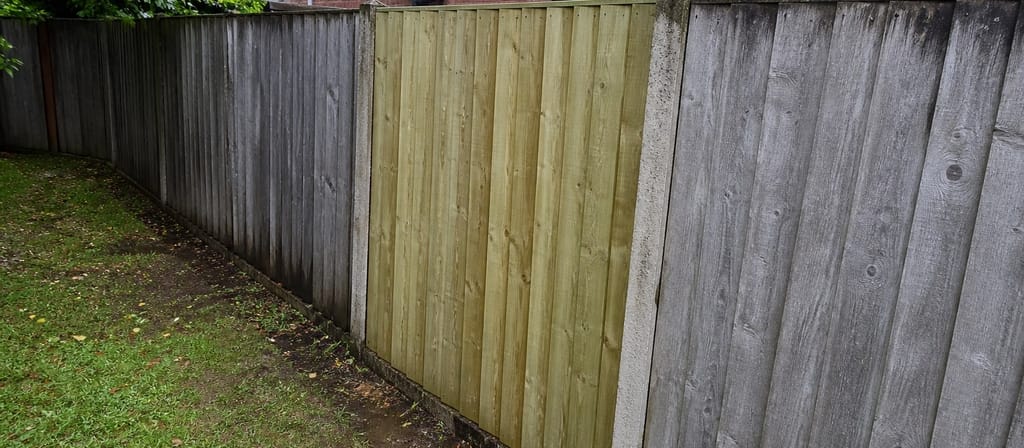
Worth saying before we fit it rather than after. A new panel next to panels that have had a few Bristol winters on them will not match, and it will keep not matching for a couple of years while it weathers down to the same silver grey. That is timber doing what timber does, not a fault, and no treatment makes it disappear overnight.
Three ways people deal with it. Accept the mismatch and let it even out, which is what most do and costs nothing. Treat the new panel a shade darker so the jump is less obvious for the first season. Or treat the whole run at once so everything moves together. We will tell you what each involves and leave the choice with you, because this is a look question rather than a structural one.
Standard panel sizes against the openings that actually exist here
Panels are made to a standard. The usual width is 1.83 metres, and heights step up through roughly 0.9, 1.2, 1.5 and 1.8 metres. That works beautifully on an estate laid out after the war, where the posts were set to the panel.
It works far less often on a Victorian terrace in Bedminster, Bishopston or Fishponds, where the gardens went in on old field lines and the gap between two posts is whatever it happened to be when somebody dug it in the 1890s. So we measure the opening rather than assuming a panel drops into it. What we do next depends on the gap:
- Slightly narrow. The panel is cut down and re-battened at the cut edge, so the boards are held properly rather than left loose. That is a real job with a proper finish, and it is not the same as sawing the end off and hoping.
- Wider than a panel. The two honest options are a new post to close the gap, or a panel made to the measurement. We price both and say which we would do on your boundary.
- Concrete posts with slots. The slot fixes the width for you, so the panel has to be cut to suit it. Easy to get wrong by a few millimetres, which is why we measure the slot itself rather than the gap between the posts.
One panel going is often the first of several
Panels put up on the same day, on the same boundary, facing the same weather, tend to fail within a year or two of each other. When we are there for one, we look at the rest of the run and tell you which ones are close and which have years left.
That is not a nudge towards a bigger job. It is arithmetic: once we are set up on your boundary, the second and third panel are quick, and doing three now costs less than three separate visits over eighteen months. Where the rest of the run is genuinely fine, we say that, fit the one, and go.
Getting to the back garden
On a lot of the terraces we work in, the only route to the rear boundary is through the house. That is a real cost and it belongs in the quote rather than in a surprise on the day, so we ask about it before we come out.
- Is there a side return or a rear lane, and how wide is the narrowest point of it?
- If the route is through the house, we bring the panels in wrapped and put covers down. It is slower and we allow for that.
- Where can the van stand while we unload, and is it a permit street?
- Is there somewhere in the garden to stand the old panels while we work?
Access is usually why two jobs that look identical on paper come back with different prices. We would rather explain that than have the number look like it was picked out of the air.
What happens to the old panel
It goes with us, and disposal is inside the price we quoted rather than added at the end. If you would rather keep it, say so when you book and we will cut it down and stack it where you want it. Either way, nothing is left leaning against the shed for you to deal with at the weekend.
Got a gap in the fence?
Send a photo of the panel and the two posts either side of it, plus the width of the gap if you can reach it. That is usually enough for a price. Weekdays 8am to 6pm, Saturday 8am to 1pm, and anything sent through the form gets a callback the next working morning.