
Garden gates and driveway gates in Bristol
Side gates, pedestrian gates and gates across an entrance. Built to the opening you have rather than to a catalogue size, and hung on posts set to carry the weight.
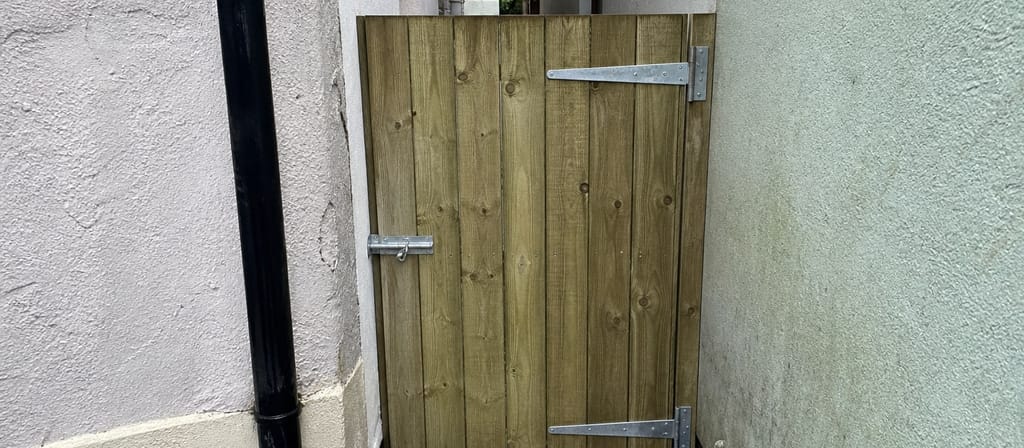
Side gates and pedestrian gates
Most of the gates we hang are the everyday ones. A side gate on the return between the house and the boundary. A garden gate at the end of a path. A gate let into a run of closeboard so the bins have a way out without going through the kitchen. Small jobs, and the ones with the most ways to go wrong, because a gate is the only part of a fence that has to keep moving for the next twenty years.
Two things decide whether it still shuts properly in five winters: the opening it was built to, and the posts it hangs on. Everything after that is fittings.
Made to measure against a stock size
A stock gate is built to a set width and a set height, and it quietly assumes the opening is square. In a Victorian Bristol terrace it very rarely is. The streets off Gloucester Road went in from the 1880s on the lines of the fields that were there before, and Bedminster and Southville were built for the tobacco and pit workers. Side returns in that stock are narrow, walls have moved since, and an opening is often wider at the top than at the bottom.
So we measure the opening at the top, the middle and the bottom, check both sides for plumb, and build the frame to what is actually there. Where a stock size genuinely fits and you would rather not pay for a made to measure gate, we say so.
The posts carry more than people think
On a plain run, a post holds a panel still. On a gate, that same post takes the whole weight of the leaf hanging off one side of it, plus the shove every time somebody pushes through with both hands full, plus the wind load on a solid gate that behaves like a sail. Gate posts get set deeper and heavier than the run they sit in, and post choice matters more here than anywhere else on the boundary.
The ground under Bristol is not one thing either. The British Geological Survey flags the Lias Group as containing swelling and shrinking clay with medium volume change potential and some high layers. The Avon and Frome valley floors are alluvium, typically under five metres deep. Much of east Bristol sits over Pennant Sandstone. A post hole in Fishponds and a post hole in Bedminster are two different jobs, and a gate post is where that difference shows up first. More on that on our posts, concrete and gravel boards page.
Hanging and ironmongery
- Hinges sized to the leaf. A heavy closeboard gate on light hinges drops inside a season. We size to the weight and the width, not to whatever came in the bag with the timber.
- A drop bolt on a pair. Two leaves need one of them held still, or the latch has nothing to bite on. The bolt drops into a socket set in the ground.
- Self closing where you want it. Rising butt hinges or a spring closer, so the gate ends up shut behind whoever went through instead of swinging.
- A latch that works from the side you use it from, and a lock on a side gate that is the only way round a terrace.
- A stop. A gate with nothing to stop it swinging past its frame will pull its own hinges out of the post eventually.
Ironmongery is cheap next to the labour of hanging the same gate twice. We fit the better hinge at the start and say why.
Driveway gates
A pair of driveway gates is the same problem at a larger size, with two extra questions attached: how wide, and where does the leaf go when it opens.
Width is not simply the gap between the posts. A car needs room to turn in, and the wider the opening gets the heavier each leaf becomes, which puts the question back on the posts again. The sweep matters just as much. A leaf opening inwards needs clear ground for its whole arc, with nothing parked, planted or stored in the way, and on sloping ground it needs the ground to fall away from the swing rather than rise into it. We mark the arc out before anything is ordered, because it is cheaper to find that problem with a piece of chalk.
The part nobody volunteers: gates that open outwards over a public footway are a highway matter, not only a planning one. A leaf swinging across a pavement is crossing somebody else's right of way. We would rather hang the pair to open inwards, or set them to slide along the boundary, than leave you with something a highway officer can object to later.
How high a gate is allowed to be
Fences, walls and gates are permitted development up to 2 metres, or up to 1 metre where they border a highway used by vehicles or its footpath. Conservation areas, listed buildings and Article 4 Directions override this.
Source: Bristol City Council, check if you need planning permission. The 1 metre limit is the one that catches a gate at the front of a house on a through road.
There is a second rule that catches more people, and it works backwards from what anyone expects. In some Bristol streets, taking an old gate, wall or fence down needs permission even where putting a new one up would not. In Henleaze that has been the position since 22 April 2021, and in the Cotham and Redland conservation area since 4 November 2012. If your address is inside either, the demolition is the part to ask about, not the new gate.
We check the address, not the postcode. The whole picture is on our planning, Article 4 and boundary checks page.
What we need before we can price a gate
- The opening measured at the top and the bottom, or an invitation to come and measure it ourselves.
- Which way you want it to open, and what is behind it when it does.
- What the posts are going into: soil, made ground, a concrete apron, or hard up against an existing wall.
- Whether the gate faces a road or a footpath, because that decides which height limit applies.
- Whether anything is coming down first, and which street you are on.
Send those over and we come back with a written price listing the gate, the posts, the ironmongery and the labour separately. We never cold call and we never knock doors.
Get a price for a gate
Send us the opening size and which way it needs to swing. Anything through the form gets a callback the next working morning.