
New garden fencing installed in Bristol
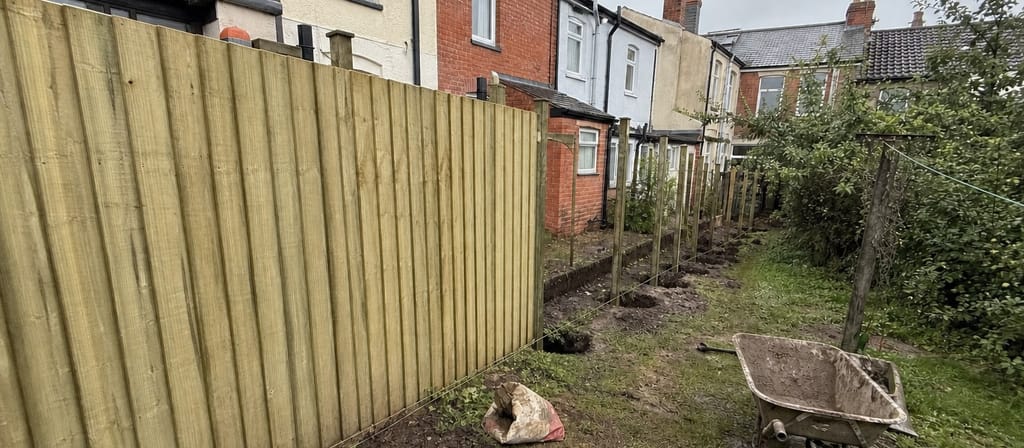
Full boundary runs built on the line rather than dropped in as a kit. Line pegged, levels taken off the high end, posts set and left to go off before a board goes on.
Closeboard, feather edge, hit and miss or panel
Four things get sold as if they were the same product. Picking the wrong one for the boundary you have is the most expensive mistake on this page.
Closeboard. Posts, arris rails, a gravel board, then vertical boards nailed on one at a time with an overlap. Built on the boundary rather than bought in sections, so it follows a slope, runs to an odd length, and can be repaired a board at a time years later. Heaviest of the timber options and the dearest. On an exposed line it is the one still standing.
Feather edge. This is the board, not the fence: thick along one edge and thin along the other so the boards lap tight. Site-built closeboard uses them, and so do the prefabricated feather edge panels sold in sections, which are a different thing to live with. If you have been quoted feather edge, ask which is meant.
Hit and miss. Boards fixed alternately to the front and back of the rails, with a gap between each one. Wind passes through instead of shoving, which matters on the high ground at Clifton and up by Horfield Common. It looks the same from both sides, so it settles the argument about the good side. It uses more timber than closeboard, so it is not the budget option.
Panel. Overlap or waney lap panels dropped between posts, usually into slotted concrete. Quickest to fit, cheapest to buy, and first over in a gale, because a solid panel in a slot is a sail with little holding it down. Still the right call on short sheltered runs and low boundaries.
What the timber is and how long each option lasts is on the timber and post guide.
How we set a run out
The order matters more than the materials. A good fence in the wrong sequence still moves in its first winter.
- Line pegged and agreed first. String line down the boundary, pegs at both ends, and you looking at it before a spade goes in. Where the line is shared, we would rather talk to next door now than after the old fence is out.
- Levels off the high end. Set a sloping run from the bottom and the top of the fence wanders. Work down from the high end and every step is the same, which is the difference between a run that looks deliberate and one that does not.
- First hole before all the others. Old footings, made ground, a service run nobody marked: all cheaper to find in the first ten minutes than the last hour.
- Posts set, then left alone. Plumbed, braced, and the concrete given time to go off before anything hangs on it. That is why a proper run is usually two visits, and we say so at the quote rather than on the day.
- Gravel boards, rails and boards last. Gravel board first so the timber above never touches soil, then rails, then boards.
Bristol's slopes cost more than the same length flat
Very little in this city is level. A boundary that drops away from the house is a stepped run: a longer post at every step, more concrete in the ground, and a gravel board cut where the ground falls under it. Same metres, more work, longer day. We price stepped and level sections separately and show you which parts of your boundary are which. Anyone quoting a flat rate per metre on a hillside garden here has not walked it.
How high you can go
Permitted development for fences, walls and gates: up to 2 metres, and no more than 1 metre where the boundary borders a highway used by vehicles or its footpath. Conservation areas, listed buildings and Article 4 Directions override this.
Bristol City Council, check if you need planning permission: bristol.gov.uk
The 1 metre limit is the one that catches people, because it applies to front gardens on any road used by vehicles and to the footpath alongside it. Height is measured from ground level on the higher side, which matters where a garden sits above the pavement. More than the rule allows is a planning application, not a fencing decision.
Conservation areas, and the streets where taking a fence down needs permission
Bristol has 33 conservation areas covering roughly 30 percent of the city, which is why we check an address rather than a postcode.
The part almost nobody mentions is that in some parts of Bristol you need permission to demolish a gate, fence or wall, not only to put a new one up. The Article 4 Directions naming boundary treatments:
- Henleaze, from 22 April 2021. Permission needed to demolish a gate, fence, wall or any other means of enclosure.
- Cotham and Redland conservation area, from 4 November 2012. Permission to demolish a front garden wall, fence or gate, and to form hard standings.
- Grove Wood, Blackberry Hill, from 9 November 2009. Alterations, constructions and extensions to walls, gates, fences and other means of enclosure.
- Henbury, from 1971, and land at Sherrin Way, from 26 July 1982. The erection of boundary treatments.
We check your address against the council's mapping before we price, not after the old fence is in the skip. The longer version, including whose boundary it is in the first place, is on planning, Article 4 and boundary checks.
Kingswood is South Gloucestershire
If your address is in Kingswood, none of the above applies to you. Kingswood sits under South Gloucestershire Council, which keeps its own conservation areas, and Kingswood is not one of them. It carries no Article 4 Direction either, so standard permitted development is the rule: 2 metres, or 1 metre next to a highway used by vehicles or its footpath.
What a new run costs in Bristol
Length is the smallest part of the number. What actually moves a fencing quote here:
- Access. A rear lane or a wide side return, against carrying every post and bag of ballast through the house. Usually the biggest difference between two runs of the same length.
- Level or stepped. A hillside boundary is more posts, more concrete and more cutting.
- What is coming out. Old posts set in concrete have to be dug out and taken away, which is a morning before a new post goes in.
- Post choice and style. Panel is cheapest per metre. Closeboard and hit and miss cost more and last longer.
For a published Bristol figure to check any quote against, ours included: Checkatrade's Bristol fencing listing publishes a range of £832 to £1,887 for installation, with an average around £1,248.
Third-party market figures published by Checkatrade for Bristol. They are not our price list, and we did not set them.
Our number comes off a measure of your actual boundary, with the access looked at and the ground checked. What we measure and what goes in writing is set out on how we quote.
Putting a new boundary in?
Send the rough length, whether it steps or runs level, and how we would get to the back garden. That is enough for us to tell you what is sensible before anybody comes out. Weekdays 8am to 6pm, Saturday 8am to 1pm, and forms get a callback the next working morning.